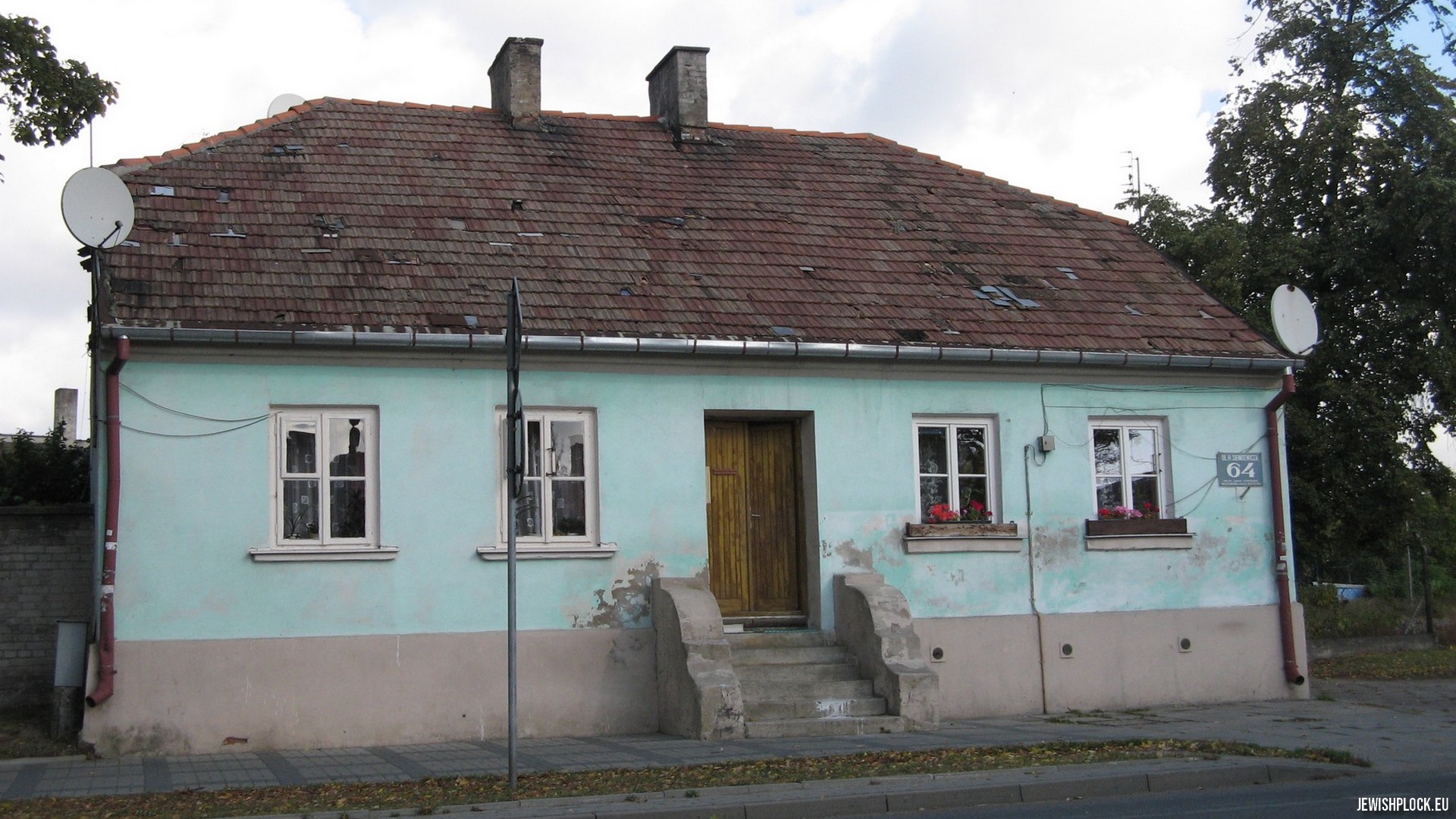
An inconspicuous one-story house at the exit of Sienkiewicza Street, at number 64. Every day it falls into more and more decay. At first glance, it does not stand out as anything special, although its history and the history of its residents is unique.
These days I think intensely about this place and the people who used to live here. The more so that a few days ago we commemorated the 80th anniversary of the Warsaw Ghetto Uprising.
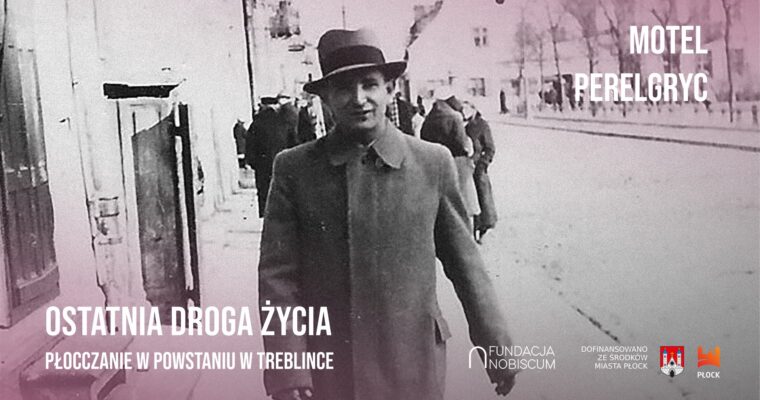
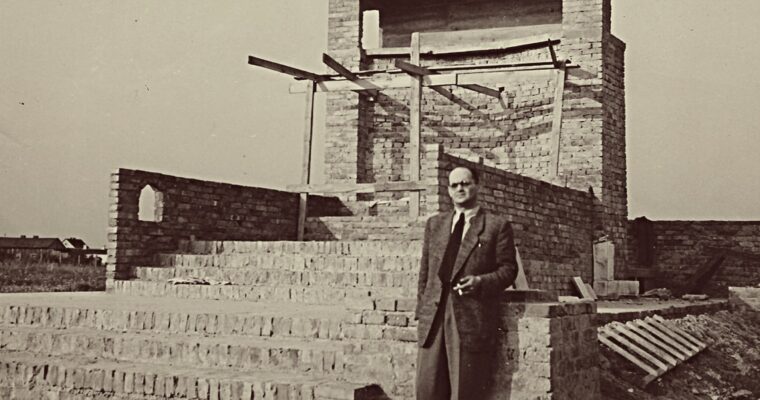
In the post-war files of the Municipal Court kept in the resources of the State Archives in Płock, in the files for recognition as deceased and for confirmation of death, information provided by Ewa Guterman regarding her husband Simcha has been preserved. We can read here that in 1941 Simcha Guterman was transported by the Germans to Starachowice, from where he escaped to Warsaw, where he stayed until the outbreak of the uprising on August 1, 1944. That he took an active part in the fight against the occupier. And that he was a member of the Jewish Combat Organization.
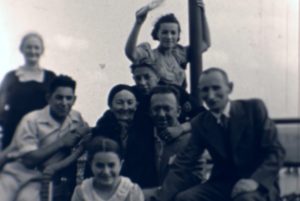
Souvenir photo on the steps of the house
Simcha Guterman was born on September 1, 1903 in Warsaw, the son of Menachem Mendel, a Talmudist, and Bajla Gitla née Fiszman. His mother came from a wealthy family from Kozienice on the Zagożdżonka River. The Gutermans were a large and loving family. During World War I, they moved to Płock, where Menachem Mendel’s brother, Rachmil, lived.
Simcha Guterman, after serving in the infantry of the Polish Army, set up a knitting workshop in Płock, where his mother and sisters worked. He soon became a well-known activist in the town. He was one of the co-founders of the local branch of the “Frajhajt” Cultural and Educational Association in Poland. The organization, which had a social democratic character and was associated with Poale Zion-Right, played a dominant role in the Zionist youth movement in the country.
In 1933, Simcha married Ewa Alterowicz (born 1908), daughter of Jakub and Necha née Tyszman, from Płock. Ewa also came from a large family, she had three brothers and two sisters. The young couple lived in a one-story house on Sienkiewicza Street, in a property that had been owned by Rywen Kanarek before the war, and earlier, for decades, by the Wasserman family. The residential building was most likely erected in the second half of the 19th century – its outline can already be seen on the provincial plan of Płock drawn up around 1882 (in the collection of the Scientific Society of Płock).
In 1935, Ewa and Simcha’s son, Jakub (Yaakov), was born. Shortly after the birth of the child, the Gutermans took a commemorative photo on the steps of the house on Sienkiewicza Street. The photo was most likely taken in the summer: smiling Ewa holds little Kuba in her arms, and his bright, knitted hat slides down on his face, Simcha is sitting right behind his wife, embracing her with his arm. His face shows seriousness and concern.
… and Aunt Małka’s enchanted orchard
Jakub Guterman recalls: “In the beginning there was a small two-family house, a bit isolated from the other buildings on the street, a modest house with concrete steps leading to the entrance. At the back, just below the window, fragrant colored peas writhed towards the sun around a stick stuck in the ground and I, a four-year-old kid, watered it every day, admiring how this tiny grain sown in the ground still sends its green arms to the sky, to finally burst into a colorful intoxicating symphony. Right next to the house there was a church and a massive seminary building, and opposite those was the enchanted garden of my childhood, aunt Małka’s orchard, where all the fruits of the world seemed to have grown, and in the thicket of currant and gooseberry bushes it was easy to get lost, as it was not easy to know where the orchard ended. Perhaps it reached the poor wooden houses of ‘Czarny Dwór’ [‘The Black Courtyard’] or maybe it reached even further, to the front of the Mariavite Cathedral itself. That was the end of the familiar world, a sandy, high and sloping escarpment flowing into the majestic Vistula River. And even further away there was only a bluish haze hiding the secrets of the world. My world was located within the borders of Płock, it was bright and radiant, and it was surrounded by the great love of my parents…”
Nothing could be done. Father was so eager to fight
The Gutermans lived in a house at Sienkiewicza Street until the establishment of the Płock ghetto in September 1940 – they were then displaced to a cramped apartment on the third floor of a tenement house at Kwiatka Street, then known as Breite Strasse, and later, on March 1, 1941, together with thousands of Płock Jews, deported to the transit camp in Działdowo.
In 1943 they found themselves in Warsaw. Simcha worked in a knitting workshop of the Mariavite sisters, Ewa and Jakub lived on the fourth floor of a tenement house at Żelazna Street. Soon the couple decided to place Jakub with the family of one of the Mariavite sisters in Wygoda near Łowicz. The boy worked until the end of the war as a shepherd in the nearby village of Zawady.
According to archival documents, Simcha Guterman became involved with the Jewish Combat Organization. He took part in the Warsaw Ghetto Uprising, which broke out on April 19, 1943, and then in the Warsaw Uprising in the summer of 1944. As his son Jakub recalled: “Mom begged him, explained to him that we had suffered enough, that we survived this hell with so much difficulty.
“Look” she said, “the Russians are on the other side of the Vistula, just a few more days of patience and we’ll be free people… After all, you’ve always protected us, Symche… we have a son, our only child…”
Nothing could be done. Father was so eager to fight. He kept repeating: – They murdered my loved ones, sisters, brothers, the whole nation. Now I will go kill them, I must avenge them.
He left home on the first day of the uprising. He was given a post-German helmet, a white and red armband, a rifle and ammunition. He was happy. Before he left, he promised my mother that if everything went well, he would come back for dinner in the evening… ”
“Leaves from Fire”
During World War II, Simcha Guterman also did an extraordinary thing that required great determination and courage. He kept secret notes, documenting the fate of Jews from Płock during the occupation. “Leaves from Fire” published in Polish by the Płock Scientific Society almost 20 years ago are an extraordinary and shocking record of a witness and participant in one of the darkest pages of the history of our city.
After the war, Ewa Guterman and Jakub returned to Płock. In the years 1945-1949 she was a member of the board of the Jewish Committee in Płock. She married Szlomo Chaim Grzebień. In 1950, she emigrated with her husband and son to Israel. She died on October 25, 1957 in Kiryat Motzkin. Jakub Guterman, a painter and illustrator, maintains constant contact with Poland and his hometown, which he has a great fondness for.
The municipality should not allow the house to deteriorate further
The walls of a small building at 64 Sienkiewicza Street witnessed the history of one of the Jewish families associated with Płock. Witnessed the great love of two people and their little child, but also the paralyzing fear, uncertainty and depressing concern for tomorrow. Although this house is not entered in the register of historic monuments, perhaps it would be worth trying to renovate it and commemorate Simcha Guterman (maybe in the form of a plaque on the facade?). The municipality certainly should not allow the house to continue to deteriorate and thus give an excuse to demolish it. Now, when we commemorated the 80th anniversary of the outbreak of the Warsaw Ghetto Uprising and recalled its first days, let us stop for a moment at 64 Sienkiewicza Street and remember the former residents of this house. The Guterman family.
The text by Gabriela Nowak-Dąbrowska was originally published in Polish by Wyborcza Płock:
https://plock.wyborcza.pl/plock/7,35681,29696491,sciany-tego-malego-budynku-byly-swiadkiem-wielkiej-milosci-i.html